You launch a campaign and it performs well. Leads are coming in, everything looks stable, and then payouts get put on hold. Shortly after, the traffic is reviewed. At the same time, ads start getting rejected during scaling, even though the setup has not materially changed. In some cases, accounts get flagged without a clear explanation.
This is what affiliate program compliance looks like. It determines whether traffic is accepted, rejected, or not paid. Below is what drives these outcomes in real campaigns: what advertisers check during traffic audits, how networks detect compliance issues, how ad platforms evaluate funnels, and where affiliate teams lose revenue without understanding the reason.
What affiliate marketing compliance means in practice
Compliance decides whether your traffic gets paid after it starts scaling. It shows up in three places: ad approval, network-side traffic review, and advertiser-side validation.
In real campaigns, nothing breaks at launch. Issues start when volume increases, patterns become visible, and different parties interpret your setup in different ways.
Problems appear when the same campaign is interpreted differently by ad platforms, affiliate networks, and advertisers. Each side looks at its own signals. Losses happen where those signals don’t align.
How do ad platform policies affect affiliate campaign compliance?
Ad platforms are usually the first place where compliance issues surface. Campaigns get limited or rejected before networks or advertisers even review the traffic. For performance agencies, this is where scaling often breaks.
Platforms evaluate not only ads, but the entire flow: creatives, landing pages, redirects, and final offers. Even small changes in the funnel can trigger re-review.
The main risk comes from how platforms interpret intent. They do not rely on your offer description or advertiser terms. They evaluate how the funnel looks to a user and whether it fits their internal policies.
Typical points where compliance risks arise:
- Mismatch between ad and landing page
If the ad promises one thing and the landing page frames it differently, campaigns get limited. This is especially common in advertorial and pre-lander flows.
- Aggressive or simplified claims in creatives
Even if the offer allows certain messaging, platforms may block ads that imply guaranteed outcomes, savings, or approvals.
- Use of “neutral” or disguised pages
Pages that look like blogs, reviews, or quizzes but function as lead funnels are heavily scrutinized. This often passes at launch and breaks during scale.
- Redirect chains and cloaking-like behavior
Multiple redirects, conditional flows, or GEO-based routing increase the chance of account review.
- Account-level signals
New accounts, inconsistent spend patterns, or repeated rejections across campaigns can trigger stricter moderation.
What makes this harder is that platform decisions directly affect compliance downstream. If a campaign starts getting flagged or limited:
- traffic structure changes
- conversion patterns shift
- advertiser-side performance drops
This is not only a platform issue. Under FTC affiliate marketing compliance rules, advertising claims must be truthful, non-deceptive, and properly substantiated, especially when they are tied to endorsements or lead generation funnels.
This creates a chain reaction where networks and advertisers begin questioning traffic quality, even if nothing changed in the offer itself. From a legal and operational perspective, this creates a gap between what is allowed under the agreement and what is actually possible to run on platforms.

Compliance risk does not come from one source. It comes from misalignment between platform rules and contractual expectations.
This is reinforced by the fact that platform rules change constantly and without coordination with contractual terms. A setup that was compliant at launch can become non-compliant during scaling, while agreements continue to treat performance as stable and controllable.
There are a few ways to reduce this risk at the agreement level:
- Define acceptable traffic sources and funnel types explicitly. If certain flows, for example, advertorials or survey funnels, are part of your model, they should be acknowledged in the agreement.
- Limit liability for platform-driven changes. Include language that protects you if campaigns are restricted, rejected, or modified due to platform policies.
- Separate performance obligations from platform constraints. Make sure KPIs are not treated as absolute if traffic delivery depends on third-party platforms you do not control.
- Align content responsibility clearly. If you generate your own creatives, responsibility for compliance should be limited to your materials, not advertiser-provided content or final product claims.
- Document platform-related changes during campaigns. If performance shifts after ad rejections or account flags, this should be фиксировано and linked to platform actions, not treated as traffic quality issues.
Finally, one point that is often missed. Platforms do not evaluate campaigns once. They continuously re-evaluate them as data accumulates. A setup that worked yesterday can fail today without any visible change.
For performance agencies, this means that ad policy compliance is not a separate layer. It directly shapes how traffic is delivered, how it performs, and whether it will be accepted and paid for later.
How do advertisers validate affiliate traffic and approve or reject leads?
Advertisers look at post-lead behavior first, but payout decisions are made during audits where they check consent, funnel logic, and whether leads actually meet the agreed Contact criteria.
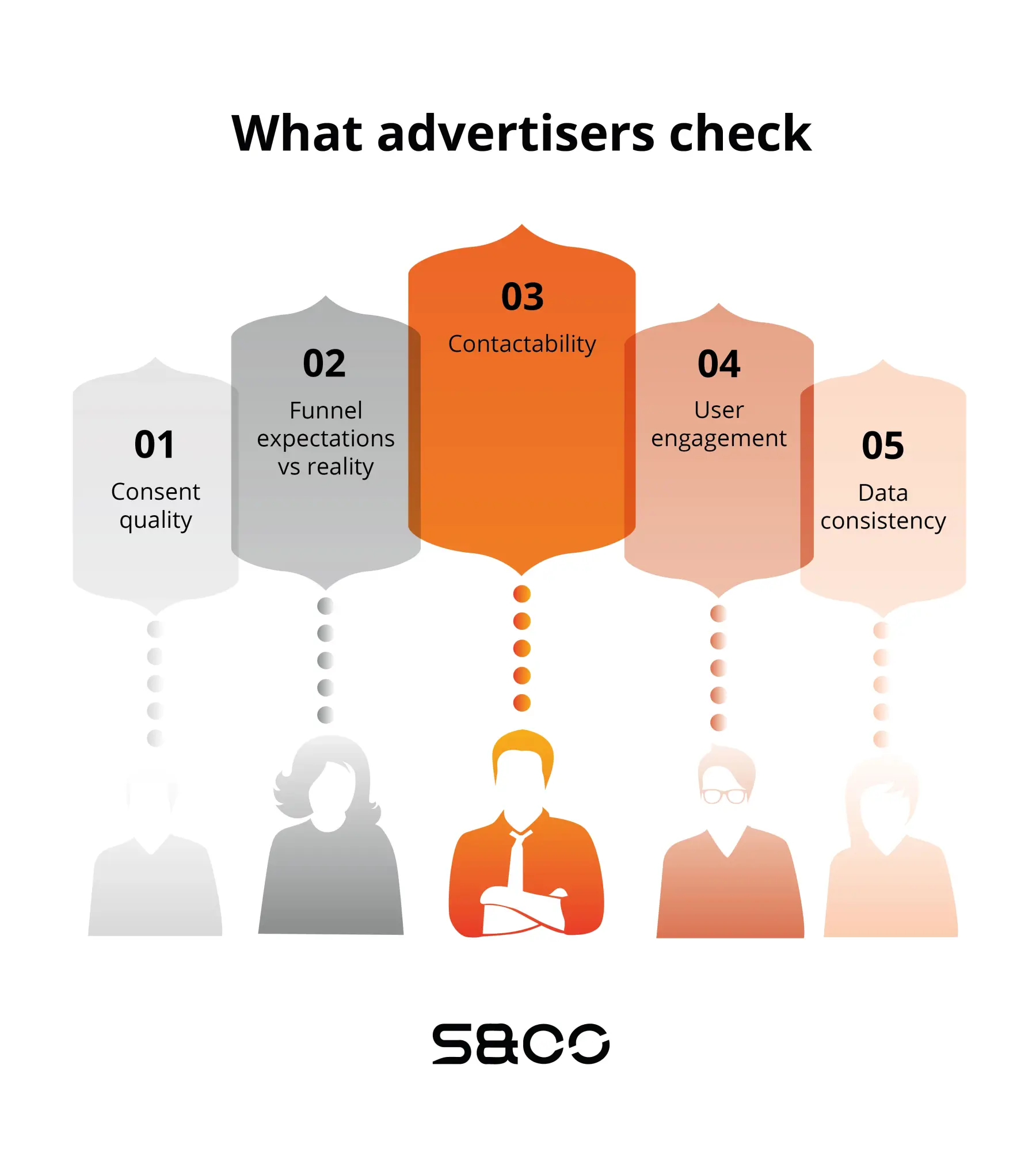
At the start of a campaign everything usually looks fine. Leads are coming in, some of them get approved, and nothing signals a problem. Issues start later, when volume grows and advertisers begin comparing what the traffic promised with what it actually delivers after the lead.
They look at a few things:
- whether user expectations match the actual offer
- how users behave after submitting their data
- where users drop off
- whether the traffic looks natural or artificially driven
This is where things start to break. Leads can be technically valid, but users do not answer calls, do not engage, or disappear after submission. From the affiliate side, everything worked. From the advertiser’s side, it did not turn into revenue.
Once this gap becomes visible, audits start.
The first thing advertisers go after is consent as part of affiliate policy compliance requirements.
They are not just checking that consent exists. They check how it was collected and whether it actually supports how the user is later contacted.They will ask for screenshots of the form, the exact wording, and technical proof tied to each lead.
The problem is usually in the details. Consent may be present, but:
- the wording is too generic
- it does not clearly cover calls, SMS, or partner outreach
- it is visually weak or hidden in the form
Under agreements like yours, this is directly linked to PEWC requirements and the obligation to provide proof within a fixed timeframe.
This is also where email and outreach compliance becomes relevant, especially under regulations like the CAN-SPAM Act, which defines how commercial communication must be structured and what qualifies as compliant user consent.
Consent should be treated as evidence, not just a checkbox. Store versioned screenshots of every funnel, tie consent text to each lead, and make sure the wording matches how the advertiser actually contacts users. If you cannot prove this within the timeframe defined in the agreement, the lead is very hard to defend.
This also ties directly to broader privacy requirements, where frameworks like GDPR compliance and CCPA compliance define how user data must be collected, stored, and used in lead generation flows.
Another problem is how a “valid lead” is interpreted.
Affiliates usually think in terms of data: correct phone, real email, completed form. Advertisers think in terms of usability. They look at whether the lead can actually be converted into a customer.
In most lead gen setups, this gap is built in. Leads are based on user-submitted data and are not independently verified before delivery. Some level of non-convertible or low-intent leads is expected and does not automatically indicate a compliance issue.
They check things like:
- whether users pick up calls
- whether contact data behaves consistently
- whether users respond or engage after submission
If this breaks, leads can be rejected even after initial approval. This is exactly where most payout disputes start.
Funnel structure is another sensitive point that often becomes a legal issue later.
Advertisers compare what the user saw before submitting data with what is actually offered. Problems appear when the funnel creates stronger expectations than the product can deliver. This happens a lot in advertorial and survey-based flows.
Typical situations:
- the page looks like independent content but functions as promotion
- survey logic suggests approval, savings, or eligibility
- messaging simplifies or exaggerates the outcome
Even if conversion is high, this mismatch shows up in user behavior and becomes a reason to question traffic.
Keep records of all funnel versions and creatives used in campaigns. Under agreements like yours, advertisers can request screenshots of submission flows, and if you cannot show what exactly the user saw, you lose control of the narrative.
There is another layer that rarely shows up in agreements but always shows up in practice. Advertisers analyze patterns inside the lead pool.
They look at signals such as:
- how quickly users act after the click
- repetition in answers or data fields
- consistency of behavior across leads
These patterns are used to decide whether traffic looks organic or overly optimized. This is rarely disclosed, but it directly affects payout decisions.
You cannot fully control how advertisers interpret patterns, but you can limit how they use this in disputes. Agreements should require lead-level evidence for rejections and not allow decisions based only on aggregated or statistical analysis. This is one of the most overlooked negotiation points.
A bigger problem is retroactive rejection and payment adjustments.
In your agreement, advertisers can reject leads if they do not meet Contact criteria, even after initial acceptance, within a defined period. In practice, this creates a situation where campaigns scale, invoices are issued, and then part of the volume gets reversed later.
This is one of the most painful scenarios in affiliate operations.
In some setups, rejection logic is not fully defined in the agreement and is instead governed by separate return policies controlled by the network or lead provider. These policies can exclude entire categories of disputes, including compliance-related ones, which limits the ability to challenge reversals.
This needs to be limited upfront:
- fix a strict rejection window
- require documented evidence for each rejected lead
- define a clear dispute process and response timelines
- restrict bulk or percentage-based deductions without lead-level review
Without this, scaling traffic always carries financial uncertainty.
One thing teams usually ignore until the first audit: record keeping.
On paper, it looks like a technical requirement. In reality, it defines whether you get paid.
Your agreement already requires storing proof of compliance and providing it within a short timeframe. In practice, many teams fail because they cannot reconstruct:
- which funnel version generated the lead
- what consent the user saw
- how the lead entered the system
Treat records as part of revenue protection. Every lead should be linked to a specific funnel version, traffic source, and consent flow. Data should be retrievable within the timeframe defined in the agreement. If not, even good traffic becomes indefensible.
How do affiliate networks detect compliance issues?
Affiliate networks start paying attention once traffic stops behaving like the baseline.
They rely on internal benchmarks built across multiple publishers. They know how traffic is supposed to behave for a given offer, GEO, and source.
The most sensitive signals are:
- Approval rate compared to other affiliates on the same offer. Each offer has an informal benchmark. If your approval rate drops outside that range, especially after scaling, traffic gets flagged.
- Mismatch between conversion rate and approval rate. High conversion with weak downstream performance is one of the fastest triggers. It usually points to overpromising in the funnel.
- Time-to-conversion patterns. Real users do not convert in identical intervals. Consistent timing patterns or very fast conversions raise flags.
- Patterns in lead data. Repetition in structure, formatting, or answers across batches is easy to detect and often treated as synthetic or incentivized traffic.
- Post-click user behavior. Networks increasingly rely on advertiser-side signals such as engagement, drop-off points, and session quality.
- Technical traffic inconsistencies. GEO, device, or IP signals that do not match declared traffic sources.
These checks are comparative. One metric alone rarely causes issues. Patterns across volume do.
Decisions are not based on a single source of data, not just network tracking:
- advertiser feedback and rejection reasons
- postback and attribution data
- cross-campaign benchmarks
- third-party fraud and scoring tools
This is why the same setup can perform differently across networks. The baseline is different.
Another factor is that network-side policies and evaluation criteria can change over time. Traffic that matched internal benchmarks at launch may fall outside acceptable ranges after scaling, even if the funnel itself has not changed.
In campaigns, reviews usually start after a clear shift:
- scaling without stable approval rate
- sudden volume spikes
- drop in advertiser-side performance
- repeated rejection reasons from advertiser
- mismatch between network and advertiser stats
At this point, traffic is reviewed retroactively, not in real time.
In some cases, networks may also suspend traffic delivery or limit distribution immediately based on suspected issues, before a full validation is completed. This creates operational risk during active campaigns.
Once flagged, networks move to traffic quality validation:
- payouts get partially held
- traffic sources and funnels are requested
- specific lead batches are isolated
- advertiser confirmation becomes decisive
Decisions are often based on aggregated patterns rather than individual leads, which makes disputes harder.
How to Secure Your Payouts
To move from passive traffic delivery to active revenue protection, performance agencies need to treat compliance as a contractual and operational system, not a checklist.
This is what you should check.

1. Define “valid lead” through measurable criteria
Most agreements fail at this level. Terms like high-quality or qualified lead give advertisers too much room for interpretation.
Instead, define:
- Technical validity
Specify required data fields and formats (e.g., phone structure, ZIP validation, required fields completeness).
- Contactability rules
Tie lead validity to process, not outcome. For example, a lead is valid if it can be contacted within a defined number of attempts over a fixed period, regardless of whether it converts.
- Explicit exclusions
List what cannot be used as a rejection reason, such as late user drop-off, change of intent, or lack of purchase after initial contact.
Without this, performance metrics will be used as a proxy for compliance.
2. Limit rejection logic and review timelines
Uncontrolled rejection windows are one of the main scaling risks.
Key elements to include:
- Fixed review window
Leads should be deemed accepted if not rejected within a defined period.
- Lead-level rejection reasons
Each rejected lead must have a specific, documented reason. Pattern-based or percentage-based rejections should not be sufficient on their own.
- Structured dispute process
Define how disputes are raised, what evidence is required, and how quickly decisions must be made.
In many agreements, rejection logic is defined outside the contract in separate policies. If this is not addressed, those policies override your protections.
3. Treat record keeping as revenue infrastructure
During audits, the ability to prove how a lead was generated directly affects payouts.
At minimum, every lead should be linked to:
- Funnel version at the moment of conversion
Landing page, pre-lander, and creative used.
- Consent snapshot
Exact wording, placement, timestamp, and technical identifiers.
- Source attribution data
Traffic source, GEO, device, and routing logic.
The key factor is not storage, but retrieval. If you cannot produce this within the timeframe defined in the agreement, the lead becomes difficult to defend.
4. Separate platform risk from contractual liability
Ad platforms continuously change policies and enforcement logic. This directly affects how traffic can be delivered.
Agreements should reflect that:
- Platform-driven changes are not performance failures
Account flags, ad disapprovals, or policy changes should not be treated as a breach or as evidence of low-quality traffic.
- Responsibility for creatives is clearly split
If you produce creatives, limit responsibility to your materials. Product claims and offer structure should remain on the advertiser side.
Without this separation, platform restrictions often get reinterpreted as traffic quality issues.
5. Monitor deviations before they trigger audits
Most compliance reviews start after patterns shift, not when rules are broken.
Internally, this should be tracked:
- Approval rate deviation
Significant drops relative to your own baseline or to other publishers on the same offer.
- Conversion to approval mismatch
High conversion with weak downstream performance often signals funnel misalignment or upcoming advertiser review.
- Behavioral anomalies at scale
Changes in time-to-conversion, lead structure, or engagement patterns.
Early detection allows you to address issues before they escalate into reversals or payout holds.