If you're a marketing agency or manage an affiliate network, the CAN-SPAM Act directly impacts your daily operations. Non-compliance means significant penalties, potentially up to $53,088 per email. Crucially, affiliate networks face shared liability: you can be held accountable for your affiliates' violations. This article offers a clear framework to ensure CAN-SPAM compliance, protecting your business from hefty fines and legal risks. So, what does the CAN-SPAM Act do?
What is the CAN-SPAM Act?
The CAN-SPAM Act is a rulebook which applies to all commercial emails sent to recipients within the US, whether those emails are going to consumers (B2C) or other businesses (B2B), regardless of the sender’s location.
Understanding and adhering to these regulations is not just a best practice, it's a fundamental legal requirement for anyone involved in email marketing.
Key Requirements of the CAN-SPAM Act
Here’s what every commercial email you send must ensure:
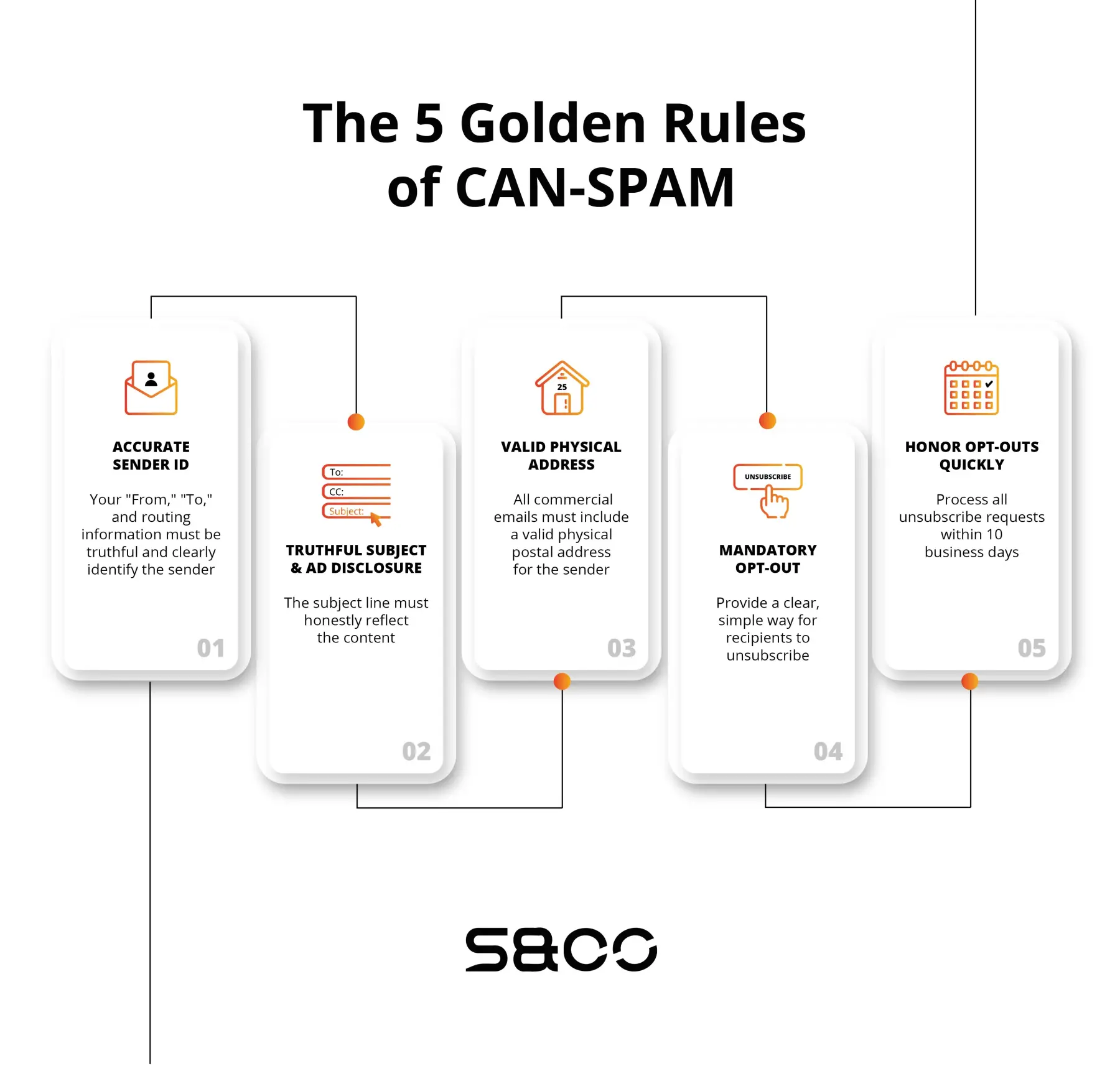
1. Accurate Sender Identification
Each email must clearly show who sent it. This means the "From," "To," "Reply-To," and routing information, like domain names and IP addresses, must be truthful and accurately identify the sender. Always use your real company name or a clearly identifiable brand name in the "From" field. Make sure your reply-to address is active and regularly monitored.
2. Truthful Subject Lines and Clear Advertisement Disclosure
The subject line must honestly reflect the email’s content and cannot be misleading. Avoid deceptive phrases if the email is promotional. Additionally, the email must be clearly and conspicuously identified as an advertisement. Its promotional nature must be obvious; don’t hide it. Consider labels like 'Ad' or ensuring the design and content clearly convey its promotional intent.
3. Inclusion of a Valid Physical Postal Address
All commercial emails must include a valid physical postal address of the sender — this can be a street address, a registered PO box, or a private mailbox registered with a commercial mail receiving agency.
4. Mandatory Opt-Out Mechanism
Provide recipients a clear, easy way to unsubscribe from future emails, typically via a link. The process cannot require a fee, extra personal info beyond their email, or multiple steps. This unsubscribe link must remain active and functional for at least 30 days. Place it prominently and test it regularly.
For example, Experian Consumer Services, operating as ConsumerInfo.com, paid a $650,000 civil penalty to the FTC for failing to comply with the Act. Their mistake? Sending marketing emails that lacked a clear unsubscribe option for consumers. Beyond that, some of these emails deceptively claimed to contain important account information when they were actually just promoting Experian's products. This case serves as a reminder that providing a straightforward opt-out and truthful email content are non-negotiable legal requirements, even for messages sent to existing customers.
5. Prompt Honoring of Opt-Out Requests
Honor opt-out requests quickly, within 10 business days. Once opted out, no more commercial emails can be sent to that address, nor can it be sold or transferred. Integrate your email platform with suppression lists to automatically process opt-outs and keep lists updated permanently.
Legal Consequences of CAN-SPAM Violations
For every single email that violates the CAN-SPAM Act, you can face a fine. The maximum CAN-SPAM Act penalty per non-compliant email is currently up to $53,088. Even a moderate-sized email campaign can lead to crippling fines if violations are detected.
CAN-SPAM for Affiliate Networks
Running an affiliate network or an agency that works with affiliate marketers means you're operating with an extra layer of responsibility when it comes to email compliance. It's crucial that not only your direct operations but also your affiliates' activities fully adhere to the CAN-SPAM Act.
The Principle of Shared Liability: Why It's Critical for Networks
If even one non-compliant email from an affiliate gets flagged, both your network and the advertiser could face massive fines. So, actively managing your affiliates' compliance is essential to protect your business.
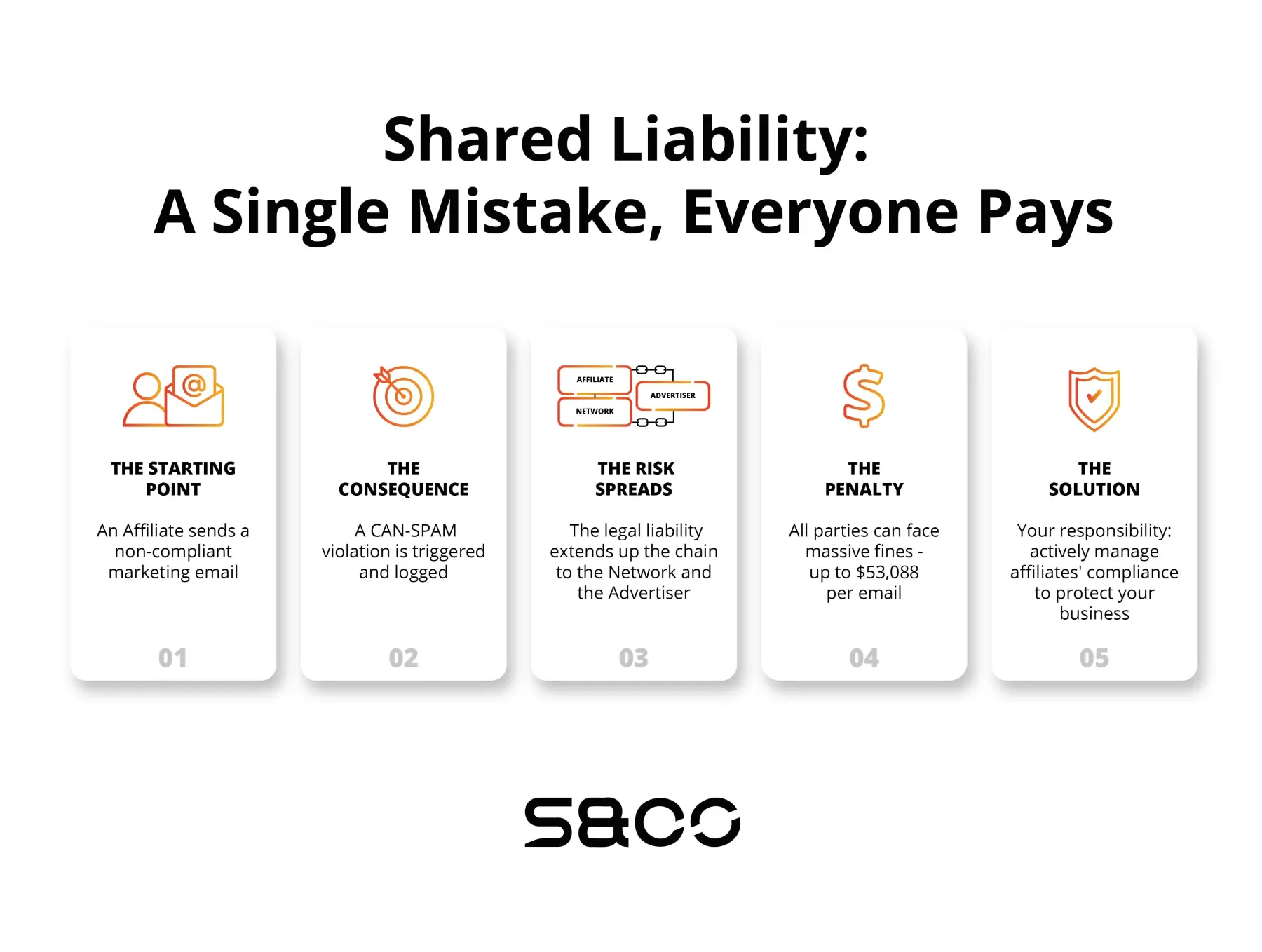
A clear example of shared liability is the FTC case against Credit Bureau Center, Revable Network (an affiliate network), and an individual affiliate. The court held all parties responsible because the network controlled the affiliate's campaign and knew about deceptive practices. This case shows that networks cannot avoid liability for affiliates' violations if they are or should be aware of non-compliance.
It's crucial to understand that advertisers, too, can be held liable for affiliate spam. Even when messages aren't sent directly by them, if they incentivize or profit from non-compliant emails, they can face legal consequences.
A CAN-SPAM Implementation Checklist for Agencies
Building a robust compliance program for your affiliate network is about safeguarding your brand's reputation and building a reliable, ethical ecosystem. Here's a practical checklist for your agency to implement:
1. Affiliate Onboarding Screening
Your first line of defense is how thoroughly you verify new affiliates. Here’s what you need to manage:
- Comprehensive affiliate review. Carefully assess each affiliate's legitimacy, accuracy of information, reputation within the industry, and past marketing activities.
- Verify contacts and legal information. Confirm their complete contact details, legal entity information, websites, and social media presence.
- Filter out suspicious emails. Automatically reject applications with obviously questionable or randomly generated email addresses.
- Sender domain verification. Ensure that any domain affiliates intend to use for sending emails are properly verified with SPF, DKIM, and DMARC. This confirms their legitimate control over the sending domain.
- Physical address confirmation. Confirm the affiliate has a valid physical mailing address that can be legally used in commercial emails.
- Email list and practice verification. Ask affiliates about how they build their email lists and request examples of emails they've previously sent for other brands. This offers insight into their compliance approach.
- Opt-out and consent record-keeping. Require affiliates to demonstrate their processes for managing unsubscribe requests, including logs with timestamps. While CAN-SPAM doesn't strictly mandate consent records, best practices suggest asking for examples of their consent forms and how permissions are collected and stored.
- Privacy Policy link. Request a link to the affiliate's Privacy Policy.
2. Create a Library of High-Quality, Compliant Email Templates
Provide your affiliates with the right tools to ensure they can easily comply with the rules.
- Develop pre-approved templates. Create email templates that inherently include correct "From" lines, honest subject lines, and appropriate disclosures clearly marking the email as an advertisement.
- Integrated opt-out links. Ensure these templates feature clear, prominent, and fully functional unsubscribe links or instructions.
- Distribute suppression lists. Provide affiliates with easy access to your network's suppression lists, via API, tools, or standardized files. Affiliates must commit to scrubbing their mailing lists against these suppression files before every single email sent.
3. Verify Affiliate Understanding of CAN-SPAM
Simply providing rules isn't enough, you need to confirm they're understood. During onboarding, provide affiliates with a concise summary of CAN-SPAM guidelines.
4. Incorporate Robust CAN-SPAM Clauses into Affiliate Agreements
Your contract is a vital legal framework. Include clear clauses requiring affiliates to follow email laws.
First up, your agreement should mandate that affiliates maintain and provide access to detailed logs of all commercial emails sent. This includes recipient consent records and unsubscribe request timestamps. Beyond this, for any commercial email sent through your program, the affiliate must adhere strictly to the CAN-SPAM content rules we discussed earlier. This means ensuring accurate headers, using truthful subject lines, clearly identifying the message as an advertisement, including a valid physical address, and providing a functional opt-out mechanism.
It’s also crucial to explicitly ban certain activities. Affiliates must not harvest email addresses, send to recipients who haven't given consent, where it's legally required, or have opted out, relay emails through unauthorized systems, or offer incentives for forwarding non-compliant emails.
Next, emphasize suppression list management. Affiliates must commit to cleaning their mailing lists against your network's suppression files (and their own) at least every three days, and always right before sending any email campaign. This prevents unwanted emails from reaching those who've opted out.
Your agreement also needs to clearly define monitoring and sanctions. This means your network has the explicit right to monitor affiliate activities, and you'll outline a clear, graduated sanctions policy for any violations.
For your protection, indemnification clauses are essential. Your contract should state that the affiliate will protect and cover your network against any claims or fines directly resulting from their CAN-SPAM non-compliance. Hand-in-hand with this is the requirement for cooperation and disclosure from affiliates. They must fully cooperate in any complaint or investigation, providing prompt responses, for example, within 48 hours, and all relevant information like email logs and creatives.
And finally, clearly state your policies on payment withholding and termination. Non-compliance must lead to immediate agreement termination, forfeiture of any unpaid earnings, and potential permanent blacklisting from your network.
Even with agreements, ongoing vigilance is non-negotiable. You need clear systems to detect and address non-compliance swiftly.
Many networks already employ various monitoring measures. You might be using tools for domain verification (like WHOIS lookups), address validation, or requiring creative pre-approval for all promotional materials. Some also utilize ongoing monitoring services to keep an eye on email activity. However, it's vital to step back and ask:
- Where might our current tools be falling short?
- Do they truly flag or prevent violations before they escalate into formal complaints or lawsuits, or do they primarily react after an issue becomes apparent?
- Are we receiving early warning signals that help us track traffic quality?
- And crucially, do our systems allow us to easily log affiliate IDs and activities, directly linking evidence of a violation to a specific affiliate?
Identifying these gaps is key to building a truly proactive strategy.
Once you spot a potential issue, you need a clear, standard way to handle it. Set up a system to log every possible violation. Also, define exactly how you'll collect evidence consistently. This evidence can come from many sources: alerts from your automated compliance tools, copies of non-compliant emails received, including full email headers, along with the exact date and time. It also covers clear identification of the specific CAN-SPAM rule that appears to be violated, like a missing physical address or a non-functional opt-out link. You should also gather direct complaints from email recipients, advertisers, or other partners, or findings from your own internal audits of affiliate creatives. Keeping careful records of these incidents is vital. They prove your network is doing its part to comply, especially if regulators like the FTC ever come knocking.
Finally, having a graduated response system for dealing with affiliate violations is a smart move. This ensures fair and consistent action, which actually encourages better behavior. Remember, outline these steps clearly in your affiliate agreements.
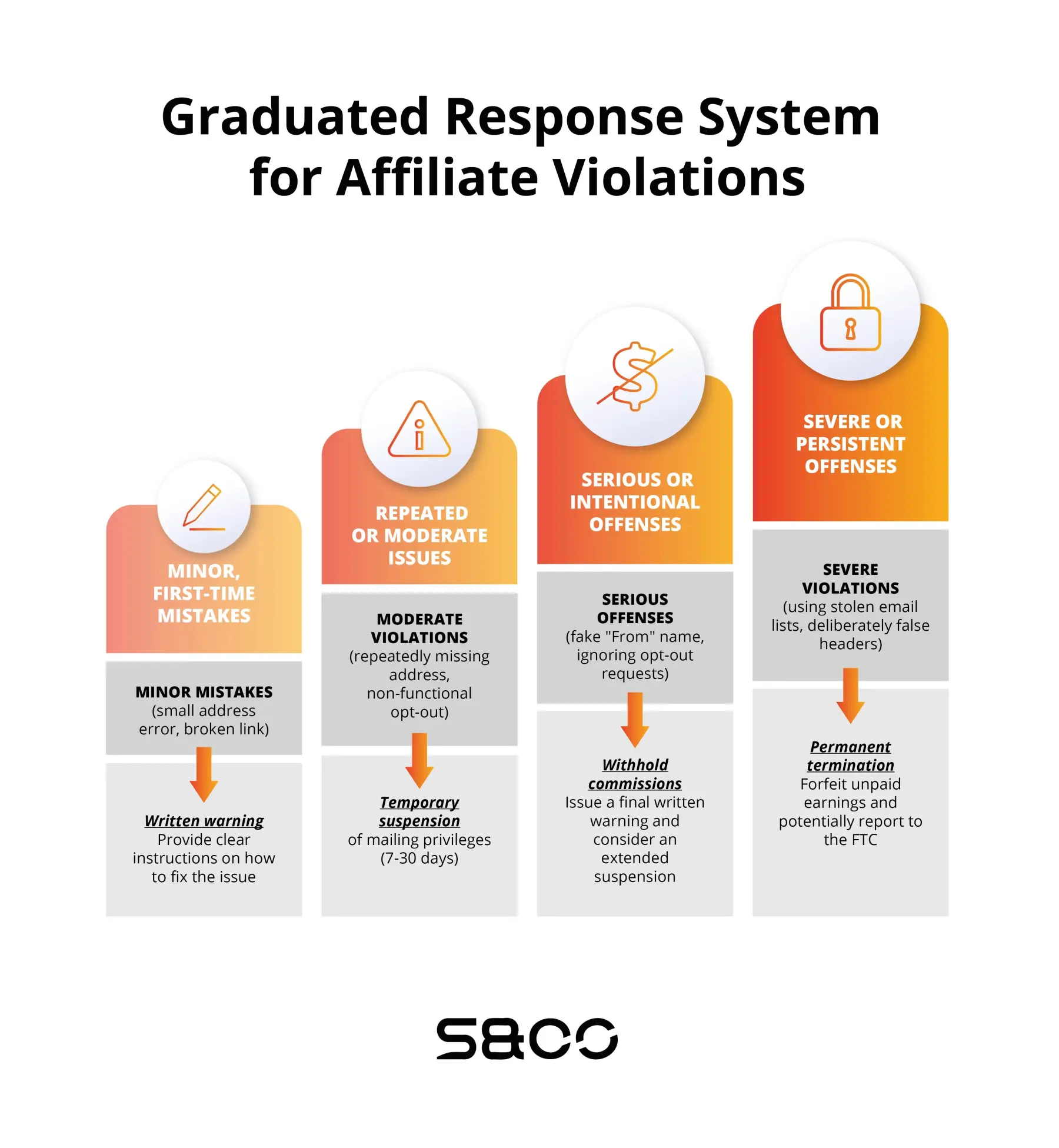
A well-defined and consistently enforced system like this doesn't just lower your legal risk. It also shows compliant affiliates that you value ethical practices, building a more trustworthy environment for everyone involved.
Final Tips for Compliance
Navigating CAN-SPAM, especially with an affiliate network, is about staying proactive. Here are direct, actionable tips to keep your email marketing compliant and your business safe:
- Audit regularly. Don't wait for issues. Proactively check your email campaigns and thoroughly vet new affiliates.
- Educate your team. Continuously train your internal staff and all affiliates on CAN-SPAM rules and best practices.
- Document everything. Maintain meticulous records of affiliate onboarding, email logs, and how every opt-out request is handled.
- Embed compliance. Make compliance a core value for your entire team and network, not just a legal obligation.
- Stay informed. Keep up-to-date with FTC guidelines and any shifts in email marketing laws.
- Leverage technology. Use email service providers (ESPs) and compliance tools that automate tasks like opt-out management and email authentication.
By following these steps, you'll not only avoid fines but also build a more trustworthy and successful email marketing program.